Magenta House Teacher Spotlight: Carina Garret
Carina Garret is a teacher from Palms Middle School who is giving her students more than what typical education does, with hands-on experience of using their knowledge to create real-world change. This is the second year she has had her class enrolled with our Magenta House program, which applies our Pando Days model for middle schools, but with a focus on water and power sustainability. We sat down to discuss her experience.
PANDO: Good morning, Carina! We’re barely more than two weeks away from the Expo! We’ve come to expect amazing work from you – I’m eager to hear what your students will be showcasing.
CARINA: Hi, Alexi! We have two teams.
One team is leading a composting initiative aimed at reducing water usage and minimizing food and carbon waste on campus.
They are beginning by educating the student body about which parts of their lunches are compostable. This helps to build awareness and shift habits.
The next phase involves using compost bins to create nutrient-rich soil that can be integrated into our school garden – reducing the need for excessive watering.
If successful, the project has the potential to significantly cut down on food waste coming from the campus, decrease landfill contributions, and reduce the environmental impact of waste transportation—a true win-win-win. The long-term goal is to expand compost use across additional green spaces campus-wide.
I love it! And the second project?
The second team is also looking at waste on campus, but not the organic kind. It’s focused on repurposing resin waste from our 3D printers.
They are experimenting with melting excess resin material into molds to create items such as Palms Middle School keychains, jewelry, and school merchandise that can be sold or distributed as incentives to support the environmental club.
Beyond the creative aspect, students are engaging in deeper analysis by evaluating the environmental trade-offs of their process. They are exploring how diverting plastic waste from landfills may reduce overall water and energy use, while also considering the energy required to melt and reshape the material.
Students are not only designing solutions, but also analyzing real-world impacts, problem-solving through challenges, and thinking critically about sustainability. Their work reflects both innovation and a genuine commitment to making a positive difference.
Wow! That is incredible. When I was in middle school, I was definitely not doing this sort of work. Now that you’ve worked with the program a while, tell me how you see Magenta House filling a gap in traditional education.
It creates a space for student voices to emerge, for students to practice critical thinking, to channel their creativity, and to have opportunity for real-world skills development that is often limited in more structured, standards-driven classrooms.
Magenta House provides opportunities for students to explore their interests, collaborate with peers, and engage in meaningful, project-based learning experiences. This degree of authenticity and ownership of work truly makes the program unique.
Let me add that for middle school students in particular, this type of program is especially impactful. At this developmental stage, students benefit greatly from environments that build confidence, encourage self-expression, and foster a sense of belonging.
Listening to you I have to conclude that the program makes students excited about learning again – and maybe even teachers about teaching!
Absolutely. Students are not only eager to apply their skills in new and meaningful ways but they also become highly engaged in the problem-solving process. There is a healthy sense of competition that motivates them, as teams work collaboratively and enthusiastically to design and develop their projects.
As a teacher, I find it incredibly energizing to listen to students’ ideas, many of which are truly astonishing in their creativity and ambition. At times, I need to help refine or scale their ideas to ensure they are feasible within our timeline and resources, but that process itself is rewarding. It allows me to guide students in turning big, imaginative concepts into actionable plans.
Overall, the experience rekindles a sense of curiosity, innovation, and purpose in the classroom—for both students and educators.
It’s probably hard to do, but what has been the high point for you?
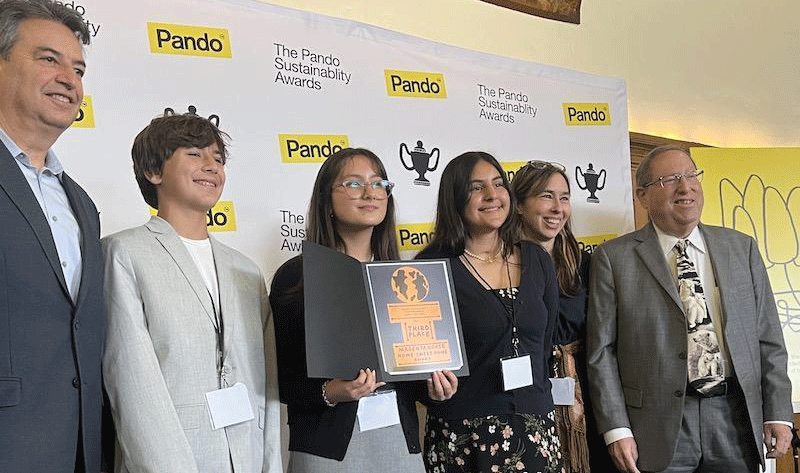
If I had to pick the single most exciting thing I would say that attending the awards ceremony with my students and their parents at Caltech was truly amazing.
To be at such a prestigious institution alongside so many college students also doing amazing work was a thrill for my students, and felt like a huge accomplishment. They were so proud to be there. And the looks I saw on their faces was truly unforgettable.
It was incredibly meaningful to witness them being recognized for their hard work, creativity, and dedication in such a setting.
I can see that. And it’s amazing to me to see that, when challenged to do so, middle schoolers can produce work that is equally meaningful in changing the world as those almost double their age.
I totally agree. It is really incredible to see how these young students really dive right into the challenge with sincerity and grit.
What has most astonished me about Magenta House is the breadth and diversity of projects it fosters among students.
Also, the fact that it places us right in the middle of the larger, and amazing, Pando community is a great gift. At the awards ceremony, I was struck by the number of innovative, thoughtful, and forward-thinking ideas being presented. The projects were not only impressive in their creativity but also in their depth and real-world relevance.
It’s energizing to be a part of that.
What do your students have to say about the program?
Their feedback has been very positive. They are excited about the direction of their projects and value the chance to contribute to something purposeful.
One challenge they have noted, however, is a lack of time to fully collaborate with their teams. Finding dedicated, focused time to work and accomplish all they hope to achieve has, at times, felt overwhelming.
This highlights both their enthusiasm for the work and their desire to invest more deeply in the process.
Do you think you’ll want to do it again next school year?
Yes, yes, and yes again!
Thank you so much for being a part of this program and for helping us turn Los Angeles Magenta!
To learn more about the Magenta House program and the ingenious work middle schoolers are doing to help save the planet, go to magentahouse.org.