Climate migration and the courage to see: an interview with Chris Doran
Pepperdine Professor of Religion Chris Doran has a new book out, Climate Migration: A Christian Call to Action in a Warming World. The book was developed in part through two Pando Day’s projects (in 2022 and 2024/25).
Our last blog post with Doran was in 2024, just after he’d finished the book manuscript. Now that it’s been published, we talked with him about it – including his themes of prophetic imagination, the courage to see, and what the humanities owe to a warming world.
PANDO: It’s great to see you again, Chris. I’m delighted to see that you have a new book out on the theme of your Pando project – focused on climate migration and a Christian response. Tell me about it. And tell me where Pando fits in.
CHRIS: It’s great to be back in the Pando orbit!
Yes, the book. Let me start this way.
I find it deeply lamentable how many Christians in the Global North fail to treat climate change as an existential threat, even as communities across the Global South are pummeled by climate disasters, with migration often their only path to survival.
In light of that, Climate Migration carefully examines Scripture’s migration narratives, as well as core Christian virtues (hospitality, solidarity, courage, justice, and hope), to develop a theological rationale for supporting those who are fleeing the ravages of climate change.
My goal is to get American Christians better equipped to empathize with and advocate for those who have already been displaced, as well as those who will eventually be displaced.
In particular, I ask Christians in the Global North to look at several biblical stories from new vantage points: from the perspective of 21st century climate change and its many consequences, and from the perspective of the migrants themselves in many of those stories.
In the end, I urge believers in the Global North to listen to what Christian theology has to say about climate migrants, and to follow God’s call from apathy to loving action.
Some of the book’s themes were worked out with students in a class called Climate Migration. Two sections of that class took part in Pando Days, so my students were engaging with the book’s themes as they completed their projects.
It is an incredible project – and one that is much needed, given the political nature of this topic and the role that Christianity has come to have in the discussion.
One thing we loved about working with you throughout Pando Days was your project’s humanities focus and focus on narrative as a vehicle for change – specifically the stories we tell and how we might reframe them to fit the reality of our most pressing challenges, such as climate migration.
I especially loved the concept in your book about the prophetic imagination and think it offers a much more important critique than most realize. Can you tell us a bit about that?
The prophetic imagination is a term coined by the late Protestant theologian Walter Brueggemann. He essentially argues that modern societies are too often constrained by what is implementable, rather than actually imagining what is possible.
On this subject, I write in the book that American Christians can too often be concerned with how immigration does or doesn’t function in the U.S., and fail to imagine what it would mean to actually treat immigrants justly or stand in solidarity with them.
Our ease at critiquing how policy is or isn’t implemented can frequently prevent us from imagining what a just alternative might actually be, and then working to bring about that change.
That’s the prophetic imagination Brueggemann was talking about.
In this case, “prophetic” has nothing to do with seeing the future – and everything to do with seeing where justice, or the lack of it, is playing out on the world stage.
That’s right.
Fascinating. Throughout your book, it seems that you are spotlighting some key Christian values in order to create fertile ground for the prophetic imagination to blossom in our age.
In your section on the virtue of hospitality, for instance, you throw this ancient value into the contemporary context of “nonpersons” that migrants often get categorized as. Can you talk a bit about that?
I adapt the idea of “nonpersonhood” from the liberation theologian Gustavo Gutiérrez, who says that one of the central problems of the modern world is who we recognize as fully human, and whose humanity is discounted or neglected altogether.
In the case of climate migrants, and really migrants of all sorts, some of the most dominant rhetoric in the U.S. and elsewhere in the Global North has tended to affirm the humanity of its own citizens while negating the humanity of migrants who may be moving merely to survive and care for their families.
When we, especially in the Global North, use the stereotypical language about migrants promoted by certain media outlets and politicians, we frequently reduce migrating humans to something less than human. They’re seen merely as an estimated number, or as criminals, or as people who steal social services. They’re not seen as actual human beings trying to make the best of a really terrible situation.
Unfortunately, there are certainly pockets of American Christianity that trade in these stereotypes more than others.
I argue in the book that Christians are likely to be judged very harshly by future generations because of it. As I often ask my students: what are people 100 years from now going to say about our anti-migrant rhetoric?
I’m terrified even to guess.
The answer is probably nothing that would convince them that Christians really care for those who are discounted or discarded by modern societies.
We have pretty foundational work to do in just seeing migrants as humans with dignity. Simply that.
I can’t agree more.
Later on, in your section on courage, you write that one of the most crucial questions that Christians in the developed world face is whether we will “engage in the courage to see.” This ties back to the idea of nonpersonhood, but framed in terms of courage – the courage to see any person, not as a migrant or member of a ethnic or racial category or a thing, but as the irrefutable person they are. Can you say more?
One of the challenges I lay out in the book is the courage to see climate migrants doing courageous things. Think about it. Think about the courage it takes for anyone to journey within their home countries, let alone venture across international borders, merely to find the basic necessities – food, water, shelter – that might allow their families to survive.
It’s amazing to me how American Protestants so frequently honor the courage of biblical figures like Ruth, Naomi, or Abraham when they read Scripture – all the while forgetting they were migrants navigating incredibly difficult circumstances. Too often we fail to acknowledge the courage of climate migrants who are doing so many of the exact same things today.
If we actually read the stories of migrants – and you’ll see that I give examples in the book of people migrating from Mexico and Central America and recognize the actual humans in those stories, we might come to acknowledge that climate migrants are doing exactly what the biblical figures did, and what we would do for our own families if we were in such a difficult spot.
Making that link is what I mean by exhibiting the courage to see. Seeing migrants as humans seeking to provide for their families is just one example of how Christians of the Global North could take part in courageous activity.
So how have readers responded so far? Have you already seen some change in the narrative?
The responses so far have been pretty positive. For example, two reviewers at a conference in June spoke highly of the ambition and depth of the project. One reviewer suggested I was likely to get negative responses from certain American Christian audiences in the current partisan political environment, since I spoke so strongly against many of the myths some Christian denominations have been perpetuating for a decade or more.
I agree with that reviewer, assuming the Christians who engage in anti-migrant rhetoric actually want to read a book about climate migration. I also did some video lectures for a Christian group in the UK and found the response there very encouraging.
Beyond theology, how do you see the humanities shaping our collective imagination? What would you say to your colleagues in the humanities?
It’s pretty clear that the scientists have unfortunately lost the battle to convince the world that climate change is real and that its consequences are going to be significant. That’s not to say climate science is unimportant, because it is in fact critical. But humans have not fundamentally changed the way we live because of the veracity of climate science.
That means one of the crucial responsibilities of the humanities is to explain how the consequences of climate change are affecting us now, and will continue to for the foreseeable future. We need the humanities to help change our hearts; science cannot do that. While I don’t necessarily see Christian theology as part of the humanities per se, theology and religion in general are definitely in the heart-change business.
Your book ends with a section on hope, and I’d like us to end there, too. What are your hopes for the project?
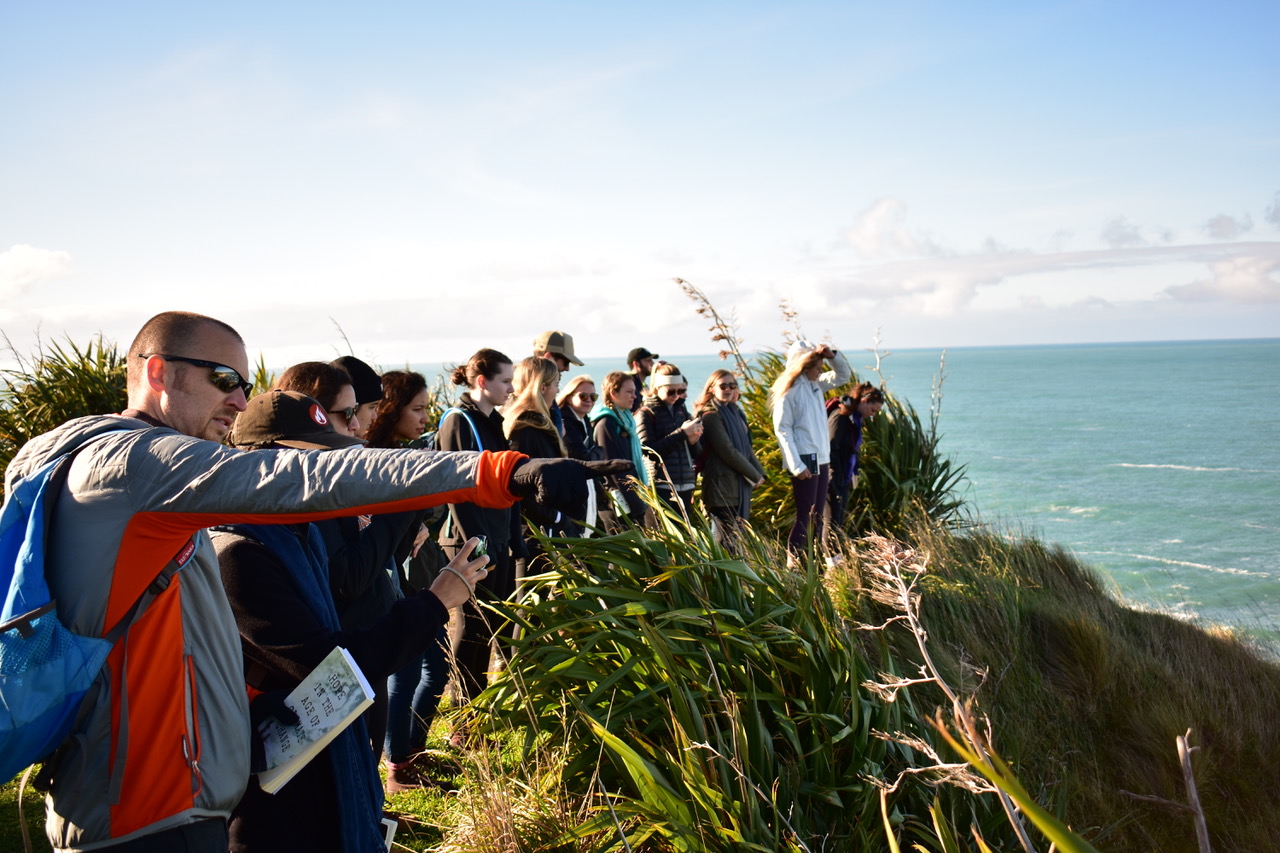
I’ve already used the book to teach college students in the U.S., as well as in New Zealand, in a U.S. study-abroad program. I would love to find others in American higher education who might be interested in using the book in their courses.
I mentioned responses from the UK. I was recently interviewed by a Christian group there. That interview is on YouTube.
I’ve also given lectures that wound up connecting me with audience members on four different continents outside of North America. I’d like to see where any of this goes.
And I would love to start working with churches directly on lesson planning based on ideas from the book.
I wish you the best of luck! And thank you for your time. I look forward to seeing more.