Two important local biodiversity opportunities for L.A.
In my previous biodiversity blogs, I’ve proposed a new term (“biometropolis”) to refer to the region of plants and animals within and immediately beyond metropolitan human settlements. I’ve also explored recent national and California advances in biodiversity planning. In this blog, I am highlighting two golden opportunities for the Los Angeles biometropolis to knit together local biodiversity plans and programs in a way that strengthens the natural ecosystems of the region. Both opportunities are functions of new programs that are statewide and even national in scope. That being the case, something will be done in the next few years to advance local biodiversity endeavors throughout LA in a way that will require at least some intergovernmental and stakeholder collaboration.
The question is: how much collaboration will occur and how will it be managed? I here offer my broad recommendations about what should be done to make local biodiversity work a success throughout the LA region. As I see it, the region has two unique opportunities: one, stemming from recent “Room to Roam” legislation, and the second from the “Green Schoolyards” movement.
1. “Room to Roam” Plans, Policies, and Strategies
As mentioned in my previous blog, California Assembly Bill 1889, the “Room to Roam Act,” was signed into law in 2024 by Governor Newsom. This act sets standards for items to be included in city and county conservation elements upon the next update of one or more general plan elements on or after January 1, 2028. Items in the conservation element update need to address issues of linkages, corridors, and other locations essential to maintain wildlife landscape connectivity.
To understand the importance of this act, it’s necessary to understand how the State of California regulates city and regional planning. All U.S. states have statutes providing for city and regional planning. In most places, complete local plans are called “comprehensive plans,” consisting of a collection of key basic plan elements. California cities and counties have such plans, although they are called “general plans” rather than “comprehensive plans.”
California’s approach to regional and city planning has historically been less restrictive than in some states, allowing counties and cities to update most of their plan elements as they see fit, rather than as required by state or regional government. While the Room to Roam Act does not change this basic approach, it does establish a requirement that any local plan update after January 1, 2028 needs to be accompanied by an up-to-date conservation plan element aligned with the Room to Roam Act. As a result, many communities are already working to ensure that their conservation elements will be aligned with the Room to Roam Act even before 2028. Then, when they need to update some other plan element, they will not be burdened with scrambling to complete an updated conservation plan element at the same time.
I’m excited for California (and L.A. in particular) to have this new opportunity to include robust biodiversity features in new conservation plans. But, I also worry about how effective those plans will be if each local community tries to identify its own wildlife corridors without regard for what its neighbors are doing. And indeed, if there is no vision for where wildlife corridors should be located throughout the larger five-county Los Angeles biometropolis, I fear that the result will be piecemeal efforts to create local wildlife corridors that don’t match the needs of the wildlife in the larger region.
What should be done instead? In my previous blogs, I’ve praised an organization called the Chicago Wilderness Alliance that I believe has an effective solution to the problem of wildlife connectivity that Los Angeles is beginning to address. On a voluntary basis, this organization has assembled a partnership of nearly 400 organizations involved in planning and implementing wildlife reserves and corridors throughout the Chicago biometropolis. One of the key accomplishments of the alliance is an identification of existing and potential locations for desirable wildlife reserves and corridors throughout the region, as depicted in this “Green Vision” map below.
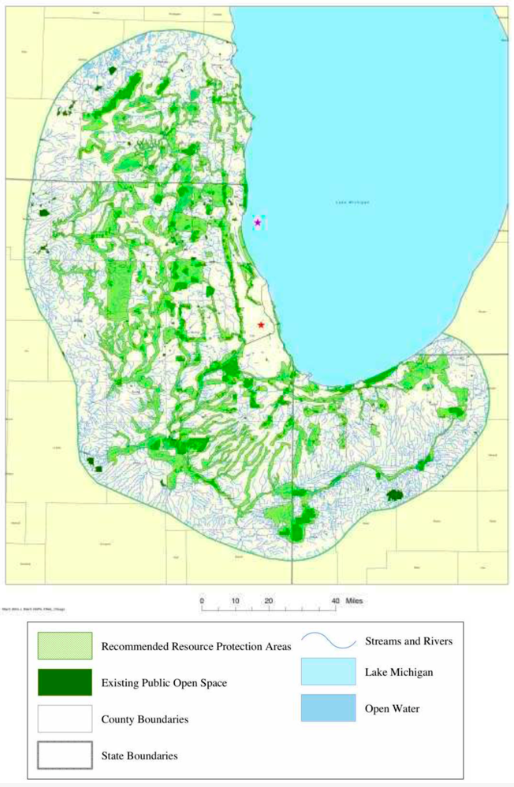
To appreciate what this map accomplishes, consider that it includes four states and 38 counties in an area comparable in size to the relevant portions of the five-county Los Angeles biometropolis (Los Angeles County, Orange County, Ventura County, western San Bernardino County, and western Riverside County). It includes existing wildlife reserves and corridors while also identifying areas of the region desirable for future wildlife preservation or restoration. It’s admittedly ambitious and acknowledges that not all of the identified areas will ultimately be preserved. Indeed, the map instead indicates search areas within which preserves and corridors should be established, typically consisting of smaller subsets of the areas identified in the map. Thereby it achieves the valuable goal of portraying the places where governmental, non-profit, and private sector partnerships should concentrate their biodiversity work.
How might such an organization and vision be established for the Los Angeles biometropolis? As a Minnesotan outsider, I don’t know the region well enough to say exactly which organizations and leaders could be involved in launching a Los Angeles Wilderness Alliance with its own Green Vision. But I do see one place where the nucleus of such a vision may be emerging.
Of the five counties in the Los Angeles biometropolis, only one (Los Angeles County) includes a border touching on each of the other four counties. And happily, Los Angeles County is now hard at work on a wildlife connectivity strategy (the “South Los Angeles County Nature Connectivity Plan”), a strategy that I’m betting will include engagement with the other four counties with geographic areas that should naturally connect with wildlife corridors in Los Angeles County. A reasonable progression, then, might be for each of the other four counties to begin crafting wildlife connectivity strategies in collaboration with their local governments, non-profits, and relevant private sector partners. These strategies could be combined with the Los Angeles County connectivity plan to yield something for the entire Los Angeles biometropolis that would be similar to the Chicago Green Vision.
As this work proceeds, it will also be helpful to draw upon research and policy established by the Southern California Association of Governments (SCAG), the regional planning agency for the Los Angeles mega-region (six counties, including Imperial County and all of San Bernardino and Riverside Counties, as well as Los Angeles, Orange, and Ventura Counties). SCAG has identified and mapped “Green Region Resource Areas” which it has determined are not suitable for future urban development. Such areas are not completely equivalent to high-quality natural resource areas, however, in that they also include agricultural areas and military installations. SCAG has also been working to create an online regional natural resource mapping tool called “Greenprint” that will complement and extend the information in its Green Region Resource Areas map.
2. “Green Schoolyards” Projects
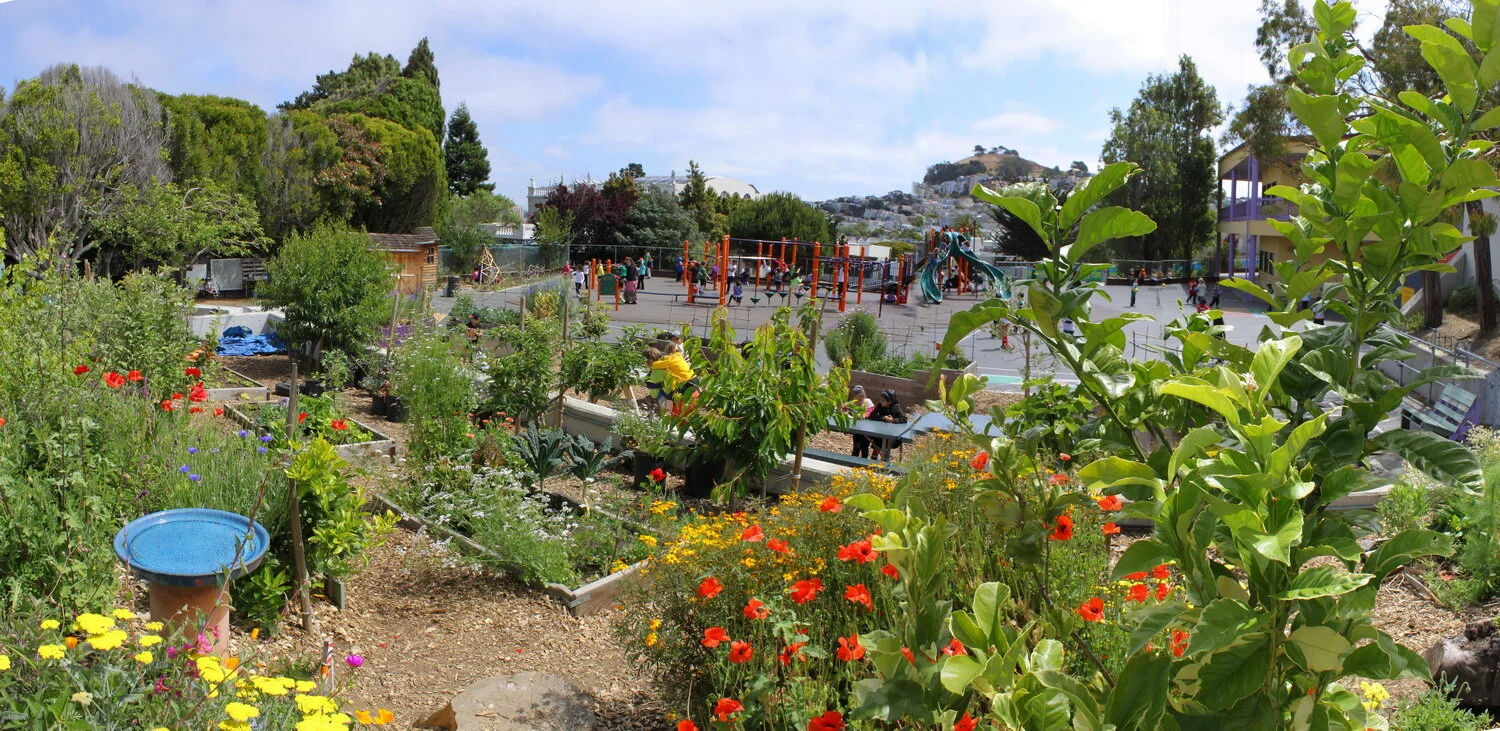
In April of 2024, the Los Angeles Unified School District (LAUSD) released a “Green Schoolyards for All Plan” designed to “ensure that at least 30 percent of the existing hard-surface schoolyard space across all District schools is converted into safe and sustainable green space by 2035.” The plan further specifies that: “Green schoolyards incorporate natural elements, offering students access to nature, shade, and play areas while promoting collaboration and learning.”
Given the long history of effective Pando work on sustainability projects with K-12 students in Los Angeles County, this LAUSD plan could be a natural fit with at least one of the Pando Days spotlight areas. Such a program could help the LAUSD plan become more tightly focused on greening projects meeting the biodiversity standards that have been established by state, county, and city governments throughout the Los Angeles biometropolis and to ensure a robust connection between biodiversity education and landscaping at each school.
Such work with LAUSD could also serve as a pilot project for extending a Pando biodiversity spotlight model into schools outside of LAUSD, not just in the Los Angeles biometropolis but to schools elsewhere in California and beyond. The Green Schoolyards model in fact originated in the San Francisco Bay Area with an organization appropriately called “Green Schoolyards America”. This organization describes itself by saying “Green Schoolyards America seeks to transform asphalt-covered school grounds into park-like green spaces that improve children’s well-being, learning, and play while contributing to their communities’ ecological health and climate resilience.” It further states that “we are working to change the paradigm for school ground design, use, and management so that all students will have access to the natural world in the places they already visit on a daily basis.” As such, I’m seeing that a wide-reaching collaboration between Pando and Green Schoolyards America might be a great fit.
With ambitions to spread the green schoolyard model throughout the nation, Green Schoolyards America has been instrumental in proposing federal legislation for national funding. Known as S.4258 – Revitalizing America’s Schoolyards Act of 2026, this legislation was introduced in the U.S. Senate on March 26, 2026, and is awaiting introduction into the U.S. House of Representatives. Certainly, approval of this act would provide further impetus for the kind of work that LAUSD has already committed to implementing.
While Green Schoolyards America and LAUSD have focused their work on K-12 schoolyards, Pando has an additional opportunity to leverage its years of successful work with Los Angeles area colleges and universities to achieve similar goals to integrate teaching, research, and campus design in a way that promotes healthy biodiversity. L.A. could become an especially robust national model for applied biodiversity education if it would combine both K-12 and higher education programs and facilities in mutually supportive ways.
In closing, I want to highlight a remarkable opportunity that, handled wisely, could even provide a distinguished international audience an opportunity to learn about successful work to integrate schoolyard design with biodiversity education. In 2031, the United States will for the first time in its history host an official “International Horticultural Exposition.” Known as “Expo 2031,” this six-month event will essentially function as a special-topic World’s Fair, with a focus in that year on efforts to harmonize the human/nature interface through horticulture. Such international horticultural expositions have occurred every few years since the late 19th century, but never before in the United States. The 2031 exposition, I’m proud to say, will be in my home region of the Minneapolis-Saint Paul Metropolitan Area. I’d love nothing more than to see a display of world-class K-12 and college/university biodiversity educational projects well-integrated with schoolyard and campus design innovations emanating from the Los Angeles biometropolis when I visit Expo 2031 in five years!